


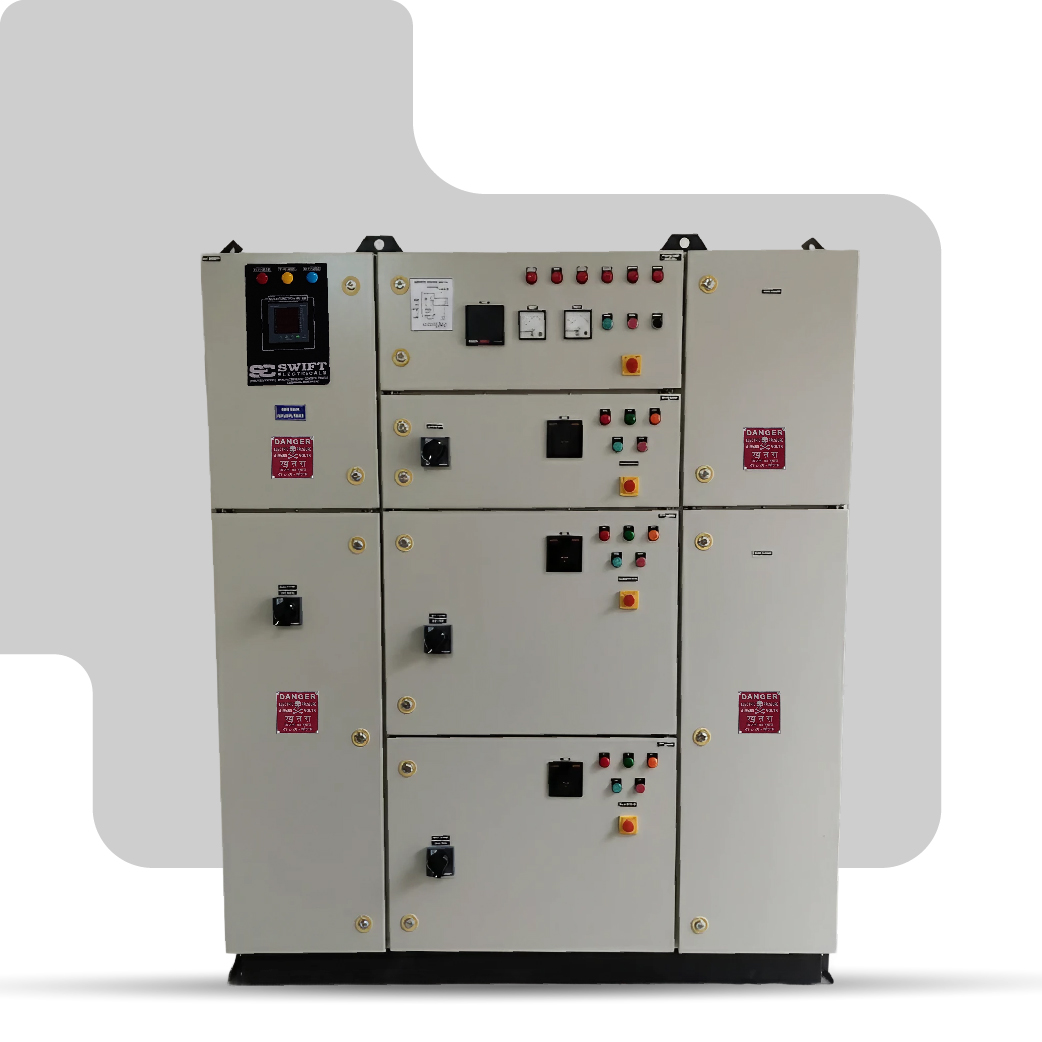
MCC Panel Supplier in India for Industrial Motor Management
Expert MCC panel supplier in India for industrial motor management solutions. Reliable, efficient, and custom-built panels from Swiftkon Electromech.
What is an MCC Panel? An Overview
A Motor Control Center (MCC) panel is a centralized assembly of motor starters, control devices, and protective components, all housed within a single or multiple enclosed sections. Its primary function is to provide a safe and organized way to control, monitor, and protect electric motors across an industrial facility. Each motor connected to the MCC has its own starter and protective devices, allowing for individual control and troubleshooting. This centralized approach simplifies wiring, maintenance, and system management, making it a cornerstone of industrial electrical infrastructure.
Key Features and Technical Specifications
When evaluating MCC panels, several technical aspects are crucial for ensuring optimal performance and longevity. These features directly impact the panel's reliability, safety, and suitability for specific industrial environments.
- Modular Construction: Allows for easy expansion and reconfiguration as operational needs evolve.
- Integrated Protection: Includes circuit breakers, fuses, overload relays, and surge protection for comprehensive motor safeguarding.
- Variable Frequency Drive (VFD) Integration: Capability to house and control VFDs for precise speed and torque management.
- Advanced Monitoring Systems: Options for real-time data acquisition on voltage, current, power factor, and temperature.
- Robust Enclosure: Designed with appropriate IP ratings (e.g., IP54, IP65) to protect against dust, moisture, and environmental ingress.
- High-Quality Busbars: Copper or aluminum busbars sized appropriately for the total connected load, ensuring efficient power distribution.
- Safety Interlocks: Built-in mechanisms to prevent accidental operation or access to live components.
- Customizable Layouts: Flexible internal arrangements to accommodate various motor starter types and control configurations.
Industrial Applications and Use Cases
MCC panels are versatile and find application in a wide array of industrial settings, supporting diverse operational requirements. Their ability to manage multiple motors efficiently makes them indispensable.
- Manufacturing Plants: Controlling machinery, conveyor belts, and automated production lines.
- Water and Wastewater Treatment: Managing pumps, aerators, and filtration systems.
- Oil and Gas Industry: Operating pumps, compressors, and processing equipment in hazardous environments.
- Mining and Minerals Processing: Powering crushers, conveyors, and ventilation systems.
- Food and Beverage Production: Driving mixers, packaging machines, and refrigeration units.
- Pharmaceutical Manufacturing: Controlling specialized processing equipment and HVAC systems.
- Power Generation: Managing auxiliary equipment and distribution systems.
- Automotive Industry: Operating assembly line machinery and robotic systems.
How to Choose the Right MCC Panel
Selecting the correct MCC panel is a critical decision that impacts operational efficiency and safety. A systematic approach ensures you procure a solution that meets your specific industrial demands.
- Assess Total Motor Load: Calculate the aggregate power requirement of all motors to be controlled to determine the necessary capacity and busbar rating.
- Identify Environmental Conditions: Consider the operating environment (e.g., dusty, humid, corrosive) to select an enclosure with the appropriate IP rating and material.
- Determine Control Requirements: Evaluate the need for basic start/stop, variable speed control (VFDs), soft starters, or complex automation integration.
- Verify Compliance and Certifications: Ensure the panel meets relevant national and international standards (e.g., IS, IEC, UL) and has necessary certifications.
- Evaluate Supplier Expertise: Choose a manufacturer with a proven track record in designing and building MCC panels for your specific industry.
- Consider Future Expansion: Opt for a modular design that allows for easy addition of new motor starters as your facility grows.
- Prioritize Safety Features: Look for robust protection mechanisms, safety interlocks, and clear labeling for safe operation and maintenance.
- Assess After-Sales Support: Inquire about warranty, maintenance services, and the availability of spare parts.
Quality Standards and Compliance
Adherence to rigorous quality standards and regulatory compliance is non-negotiable for MCC panels. These standards ensure the safety of personnel, the protection of equipment, and the reliability of operations. In India, panels often need to comply with Bureau of Indian Standards (BIS) specifications, such as IS 8623 for low-voltage switchgear and controlgear assemblies. International standards like IEC 61439 also provide a framework for design and performance verification. Buyers should verify that the manufacturer can provide documentation demonstrating compliance, including type-test reports and certificates, to ensure the panel is built to withstand the demands of industrial use and meet safety regulations.
Why Swiftkon Electromech's Experience and Capability Matter
At Swiftkon Electromech Pvt. Ltd., our extensive experience in designing and manufacturing electrical control panels, including sophisticated MCC panels, sets us apart. We understand the critical nature of motor management in diverse industrial applications across India. Our manufacturing process is guided by a deep understanding of engineering principles and a commitment to quality.
Our technical team possesses the expertise to design custom solutions that precisely match client requirements, whether it involves standard motor control or complex automation integration with VFDs and PLCs. We employ stringent quality control measures at every stage, from component selection to final assembly and testing, ensuring each panel delivers reliable performance. Our capability extends to providing panels that meet national and international standards, backed by certifications. We focus on building robust, efficient, and safe MCC panels that contribute directly to our clients' operational success and peace of mind.
Installation, Maintenance, and Care Tips
Proper installation and regular maintenance are key to maximizing the lifespan and performance of your MCC panel. Following these guidelines will help prevent issues and ensure safe operation.
- Installation: Ensure the panel is installed in a clean, dry, and well-ventilated area, away from excessive heat or corrosive elements. It should be securely mounted to prevent vibration. All electrical connections must be made by qualified electricians according to local codes and the manufacturer's specifications.
- Initial Checks: Before energizing, perform thorough visual inspections. Check all connections, ensure all protective devices are correctly set, and verify that no foreign objects are inside the panel.
- Regular Inspections: Schedule periodic inspections (e.g., quarterly or semi-annually, depending on the environment) to check for loose connections, signs of overheating, dust accumulation, and corrosion.
- Cleaning: Keep the interior of the panel clean. Dust and debris can lead to short circuits or reduced insulation resistance. Use a dry, lint-free cloth or compressed air for cleaning. Avoid using water or cleaning solvents directly on electrical components.
- Component Testing: Periodically test the functionality of overload relays, circuit breakers, and other protective devices as per manufacturer recommendations.
- Record Keeping: Maintain a log of all maintenance activities, inspections, and any repairs performed. This helps in tracking the panel's history and identifying recurring issues.
- Safety First: Always de-energize the panel and follow lockout/tagout procedures before performing any maintenance or inspection work.
Frequently Asked Questions
The primary purpose of an MCC panel is to provide a centralized, safe, and organized system for controlling, monitoring, and protecting multiple electric motors within an industrial facility. It allows for individual motor management, enhancing operational efficiency and safety.
A Motor Control Center (MCC) panel is specifically designed to house motor starters and associated control and protection devices for electric motors. A Power Control Center (PCC) panel, on the other hand, is designed to distribute power to various loads, including MCC panels, transformers, and other distribution boards, and typically contains main incomers and feeder breakers.
Key safety features include robust circuit breakers and overload relays for motor protection, proper grounding, safety interlocks to prevent unauthorized access, clear labeling of all components, and an enclosure with an appropriate IP rating to prevent ingress of dust and moisture.
Yes, MCC panels are highly customizable. They can be designed with specific types of starters (DOL, Star-Delta, VFDs, soft starters), different communication protocols for automation, specialized monitoring systems, and enclosures tailored to the environmental conditions of the installation site.
With proper installation, regular maintenance, and adherence to quality standards, a well-designed MCC panel can have a lifespan of 15 to 25 years or even longer. The actual lifespan depends on the quality of components used, the operating environment, and the maintenance practices followed.
Regular maintenance includes visual inspections for loose connections or signs of overheating, cleaning to remove dust and debris, testing of protective devices like overload relays and circuit breakers, and ensuring all safety interlocks are functioning correctly. Periodic thermal imaging can also help identify potential issues before they cause failure.
Conclusion
For any industrial operation in India that relies on electric motors, a robust and well-designed Motor Control Center (MCC) panel is a fundamental requirement. It is the central nervous system for managing motor operations, ensuring efficiency, safety, and reliability. When selecting an MCC panel supplier, it is crucial to consider not just the technical specifications but also the manufacturer's experience, commitment to quality standards, and ability to provide tailored solutions. A properly specified and manufactured MCC panel from a trusted provider like Swiftkon Electromech Pvt. Ltd. will serve as a reliable asset, contributing significantly to the smooth and productive functioning of your industrial processes.
Get In Touch
Swiftkon Electromech Pvt. Ltd.